
How to Choose the Right Air Duct Cleaning Company in Kent
Most Kent homeowners choose a duct cleaning company the way they choose a restaurant: they scan reviews, pick the highest rated, and hope for the best. That works for dinner. It doesn’t work for the inside of your HVAC system. A company can be certified, friendly, and well reviewed, and still bring the wrong tools for your duct type. Here’s how to actually tell the difference before anyone sets foot in your home.
The short answer: match the company’s equipment and process to your specific system, then verify both in a short phone conversation. It takes about five minutes. It’s the difference between a system that’s genuinely cleaned and one that just looks cleaner at the registers.
If you’d rather skip the vetting and talk to a company that will walk you through it, call (866) 761-6504. We answer 24/7.
Why “Best Reviewed” Isn’t the Same as “Right for Your System”
A review tells you whether the last customer was satisfied. It doesn’t tell you whether the technician used a rotary brush designed for flex duct or a rigid tool that scored it. Those are different outcomes, and neither one shows up in a star rating.
Kent’s housing stock makes this matter more than in some cities. You’ll find older homes with sheet-metal trunk lines and newer construction with long runs of flexible duct. Those two systems need different agitation tools and different air volumes. A company that’s excellent on galvanized steel can leave flex duct under-cleaned because their brush is too aggressive and the technician backs off to avoid tearing it. A company that only does light residential work can struggle on a commercial-grade sheet-metal system.
So the useful question isn’t “who’s the best?” It’s “who’s the right match for the ducts in my house?” Here’s what to ask to find out:
- What material are my ducts, and does your equipment change based on that?
- Do you use a rotary brush system, and which one?
- Will the technician inspect the system before quoting, or just measure square footage?
- How do you control dust during the job?
- If you find damaged ductwork, can you repair it?
Notice that none of those questions are about price. Price comes after the system is understood. A company that quotes before it inspects is quoting a guess.
Ask What Equipment They Use on Flex Duct Specifically
Flex duct is the soft, foil-and-wire spiral duct you’ll see snaking through attics and crawlspaces. It’s common in Kent homes, and it’s the system where equipment choices matter most. Its inner liner can be damaged by the wrong tool. If it tears, the duct loses its seal and starts pulling attic air into your living space.
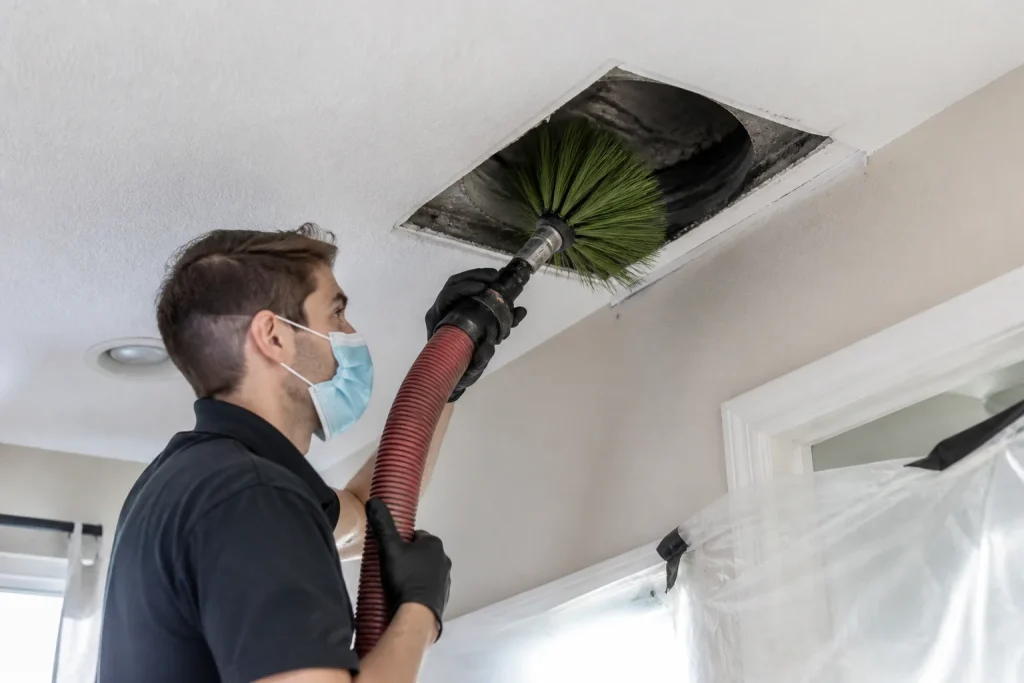
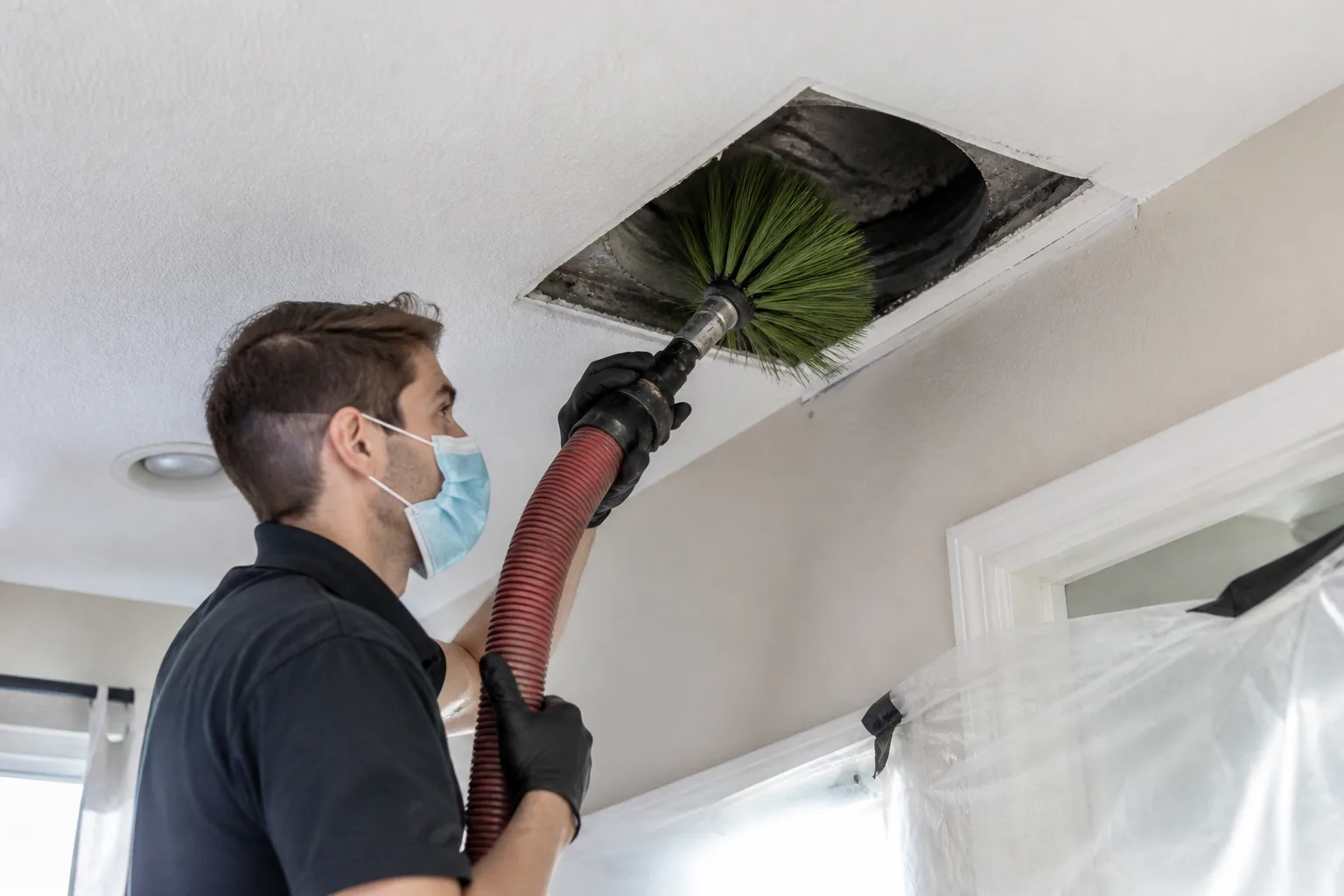
A credible answer names the equipment. Professional rotary brush systems like Rotobrush are built for this: the brush head is designed to agitate the duct wall without tearing the liner, and it’s paired with high-efficiency vacuum collection so the debris actually leaves the system. If the answer is “we use a shop vac and a long hose,” that’s not duct cleaning. That’s vacuuming the inside of a pipe and calling it a day.
At our end, we run Rotobrush and Nikro equipment because it’s purpose-built for duct interiors, not adapted from general construction tools. We also run Abatement Technologies air scrubbers on site to control particulate during the job, so the dust we’re loosening doesn’t drift through the house while we work. Your ducts are only as clean as the process used to clean them.
Ask this question plainly and listen for specifics. Companies that know their equipment will name it without hesitation. Companies that don’t will pivot to price.
How to Verify They Use True Negative Pressure
Source removal is the industry term for cleaning ductwork under negative pressure: a high-powered vacuum pulls the entire system into negative pressure, then the technician agitates the duct walls so debris is captured and carried out through the vacuum rather than into the room. Contact vacuuming is different. It’s a vacuum head passed over accessible surfaces. It looks similar from the doorway. The results aren’t.
The question to ask is direct: “Are you creating negative pressure on the whole system before you start, and how are you sealing the registers?”
A credible answer sounds like this: they connect a collection unit to the main trunk or a dedicated access port, seal the supply and return registers before starting, verify the pressure is holding, then agitate the system from multiple access points. They’ll usually mention the vacuum model or the collection unit. They’ll mention sealing.
An answer that stays vague, or jumps to “we’ve been doing this for years,” is your cue to call someone else. In our experience, “blow-and-go” operators in Kent skip the sealing step because it takes time. Without sealed registers, they’re pushing loosened debris back into the house instead of pulling it out. It’s the single most common shortcut we hear about.
What a Real Pre-Job Inspection Looks Like
Before anyone quotes a price, someone should walk the system. Not glance at the square footage on a clipboard. Walk it.
In a typical Kent home, that means a technician in the attic looking at the flex runs, in the crawlspace checking the trunk line and any disconnected joints, at the air handler verifying the blower and coil condition, and at the registers confirming airflow. They’re looking for duct material, layout, visible damage, and whether the system has been cleaned before. They should tell you what they found before they quote.
Who does the inspection matters as much as what’s inspected. A technician who will actually do the work is the right person. A sales rep quoting from a tablet by square footage hasn’t seen your system and can’t price it honestly. If the person at your door can’t describe your attic ductwork, the quote is fiction.
This is also when a company that repairs ducts earns its value. If the technician finds a disconnected flex run or a crushed section behind a joist, they should say so. Cleaning a duct that’s about to fail is wasted money. We clean it, and we fix it if it’s broken.
Red Flags Specific to the Kent Market
Most red flags are universal, but a few show up more in this area because of the housing mix and the volume of duct cleaning operators working King County. Watch for these:
- Blow-and-go without sealing. Registers not sealed before vacuum pressure is applied. Ask how they seal and listen.
- Quotes without questions. If they price your job without asking about duct material, age, or layout, they’re guessing. A written estimate should reflect what’s actually in the system.
- Equipment described vaguely. “Professional-grade” without naming it. Ask for a specific brand or model.
- No repair capability. A company that can only clean has a business model that rewards cleaning damaged ducts rather than fixing them.
- Per-vent pricing. It’s not a real number. Whole-system pricing agreed before work starts is the honest way to quote.
- No before-and-after documentation. Ask what proof of work you’ll receive.
The pattern behind all of them is the same: a company optimizing for speed and volume rather than system-specific results. That’s fine for some trades. It’s the wrong fit for ductwork, where the whole value is in what happens inside a space you can’t see.
Why “Clean Only” Companies Miss the Real Problems
If the only tool in the van is a vacuum, everything looks like it just needs cleaning. A disconnected joint, a crushed flex run, a leaking trunk collar – these are repair problems, not cleaning problems, and a clean-only company has no way to address them. They’ll clean around the damage, hand you a receipt, and the system keeps leaking.
That’s why we treat duct repair as a core service alongside air duct cleaning and dryer vent cleaning. Not because repair is more profitable, but because half the systems we open up need it. A duct that’s pulling attic air into a bedroom doesn’t get fixed by cleaning. It gets fixed by reconnecting and sealing it.
Related services in Kent include dryer vent cleaning, which addresses a leading cause of residential structure fires. It’s a short job with a real purpose. If you’re already having the system inspected, it’s a sensible addition. You can read more on our Kent service page or see the full scope on our Duct Cleaning Kent home page.
The Bottom Line
Choosing the right air duct cleaning company in Kent comes down to five questions: what equipment do you use on flex duct, do you create negative pressure and how do you seal, who inspects the system before quoting, can you repair damaged ductwork, and how do you prove the work was done. Ask them plainly. A company with real equipment and a real process will answer without flinching.
If the answers are vague, keep calling. A certified company with the wrong tools is still the wrong company for your system.
Our technicians have up to 15 years of experience with residential and light-commercial ductwork, and we’re familiar with Honeywell and Aprilaire filtration products for homeowners who want to go further on air quality. If you’re in Kent and want a straight assessment of your system, we offer a free estimate. Call (866) 761-6504. We answer 24/7. Fast dispatch from 7am to 7pm, Sunday through Friday.
Frequently Asked Questions
Pricing depends on system size, duct material, and whether repairs are needed. Most companies quote per system rather than per vent, and a written estimate agreed before work starts is the honest way to know the final number. If a quote arrives without anyone inspecting your system, treat it as a placeholder, not a price. Call (866) 761-6504 for a free estimate on your specific system.
Cheaper quotes usually skip steps: no sealing before negative pressure, no rotary brush on flex duct, no inspection before pricing. The price looks lower because less work is being done. Ask what’s included in each quote and compare the process, not just the number. Call (866) 761-6504 if you’d like a straight comparison.
Ask for before-and-after photos of your own system, taken at the access points. A credible company documents what it found and what it cleaned. If you’re not offered documentation, ask for it before the job starts. Call (866) 761-6504 with questions about what our process includes.
There’s no fixed schedule. Homes with pets, recent renovations, allergy concerns, or visible dust buildup at the registers tend to benefit sooner. Homes with a well-maintained system and no symptoms can go longer. An inspection tells you more than a calendar does. If you’d like an assessment, call (866) 761-6504 – we’ll tell you honestly whether your system needs cleaning or not.
Written by the team at Duct Cleaning Kent.
Need Air Duct Cleaning Help?
Call Duct Cleaning Kent - licensed & insured, with free written estimates in Kent.
(866) 761-6504